

How to Compare Renovation Quotations:
What Homeowners Should Look For
Planning a home renovation in Johor Bahru (JB) or Kuala Lumpur (KL)? Before choosing the lowest quotation, learn how to compare renovation quotations based on scope, materials, workmanship, exclusions, and contract terms.
Getting three renovation quotations is often recommended when planning a home renovation.
But there is one problem homeowners quickly discover:
Three quotations for what appears to be the same renovation can have completely different prices.
One company may quote RM250,000. Another may quote RM300,000. A third may come in at RM220,000.
So which one is actually better?
The answer is: you should not compare renovation quotations by the final price alone.
A renovation quotation is only meaningful when you understand exactly what is included, what is excluded, what materials are specified, how the work is measured, and what happens when the scope changes.
For homeowners in JB, KL and other parts of Malaysia, this guide explains how to compare renovation quotations properly before committing to a renovation company.
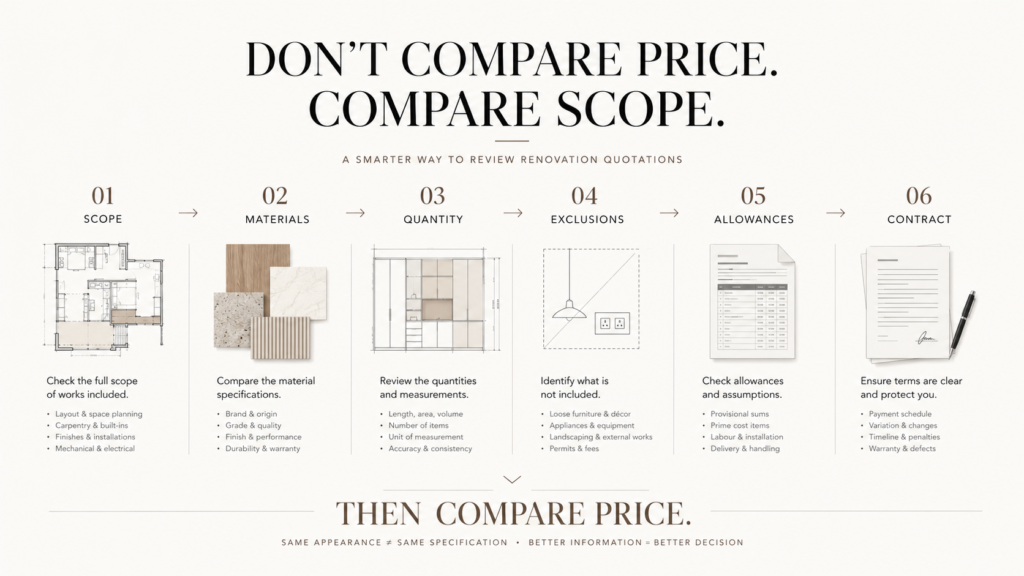
How Should You Compare Renovation Quotations?
When comparing renovation quotations, look at these seven areas:
- Scope of work — Is the same work included in every quotation?
- Material specifications — Are the brands, models, grades, thicknesses and finishes clearly stated?
- Quantity and measurements — Are you comparing the same amount of work?
- Exclusions — What is specifically not included?
- Provisional Sums and Prime Cost items — Are some costs still only allowances?
- Payment and variation terms — What happens if the scope changes?
- Warranty and project responsibility — Who manages defects, coordination and rectification?
Only after comparing these items should you compare the final price.
A lower quotation is not necessarily cheaper in the long run if important work has been excluded or allowances are unrealistically low.
CIDB Malaysia similarly recommends comparing quotations based on price, scope of work and payment terms, and warns homeowners to be cautious when a quotation is significantly cheaper without a clear breakdown of the scope.
Why Are Renovation Quotations So Different?
The biggest reason renovation quotations differ is simple:
Homeowners are often comparing different scopes of work without realising it.
For example, two companies may both quote for “custom kitchen cabinets”.
But that description alone does not tell you:
- Cabinet length
- Cabinet height
- Board material
- Board thickness
- Internal structure
- Door finish
- Hardware brand
- Drawer system
- Hinges
- Accessories
- Soft-close mechanism
- Countertop material
- Installation
- Delivery
- Site protection
- Final cleaning
One quotation may include many of these items.
Another may include only the basic cabinet construction.
Both quotations may therefore look like they are offering the same kitchen — but they are not necessarily offering the same product.
This is why a renovation quotation should be treated as a scope document, not simply a price list.
A properly prepared quotation should make it possible for the homeowner to understand what they are paying for.
CIDB’s guidance similarly highlights the importance of accurately defining the scope of work and identifying materials, labour and equipment when preparing a construction quotation.
What Should a Renovation Quotation Include?
A good renovation quotation should provide enough information for both homeowner and contractor to understand the agreed scope.
Depending on the project, this may include:
1. Company and project information
The quotation should clearly identify:
- Contractor or renovation company
- Company registration details where applicable
- Project address
- Quotation date
- Quotation validity period
- Client information
2. Scope of work
This is one of the most important sections.
It should describe the work being offered, such as:
- Demolition
- Masonry
- Plumbing
- Electrical
- Ceiling
- Flooring
- Painting
- Metalwork
- Glasswork
- Carpentry
- Built-in furniture
- Kitchen works
- Bathroom works
- Air-conditioning-related works
- Lighting installation
- Final cleaning
3. Material specifications
Instead of simply writing:
“Wooden cabinet”
a more useful quotation should specify the relevant material, construction and finish.
For example:
Cabinet carcass: specified board material and thickness
Door finish: specified laminate / spray paint / veneer
Hardware: specified brand or equivalent
Accessories: specified model or allowance
The more important the item, the more important it is to remove ambiguity.
4. Quantity and measurement
A quotation should make clear how the price was calculated where relevant.
For example:
- Per square foot
- Per foot run
- Per unit
- Per point
- Per item
- Lump sum
This allows homeowners to understand whether two quotations are actually pricing the same amount of work.
5. Exclusions
This section is often overlooked.
A quotation should clearly state what is not included.
For example:
- Authority fees
- Certain professional fees
- Loose furniture
- Appliances
- Curtains
- Decorative lighting
- Specialist equipment
- Structural works outside the agreed scope
The exact exclusions depend on the project.
The important point is that you should know about them before signing, not after construction begins.
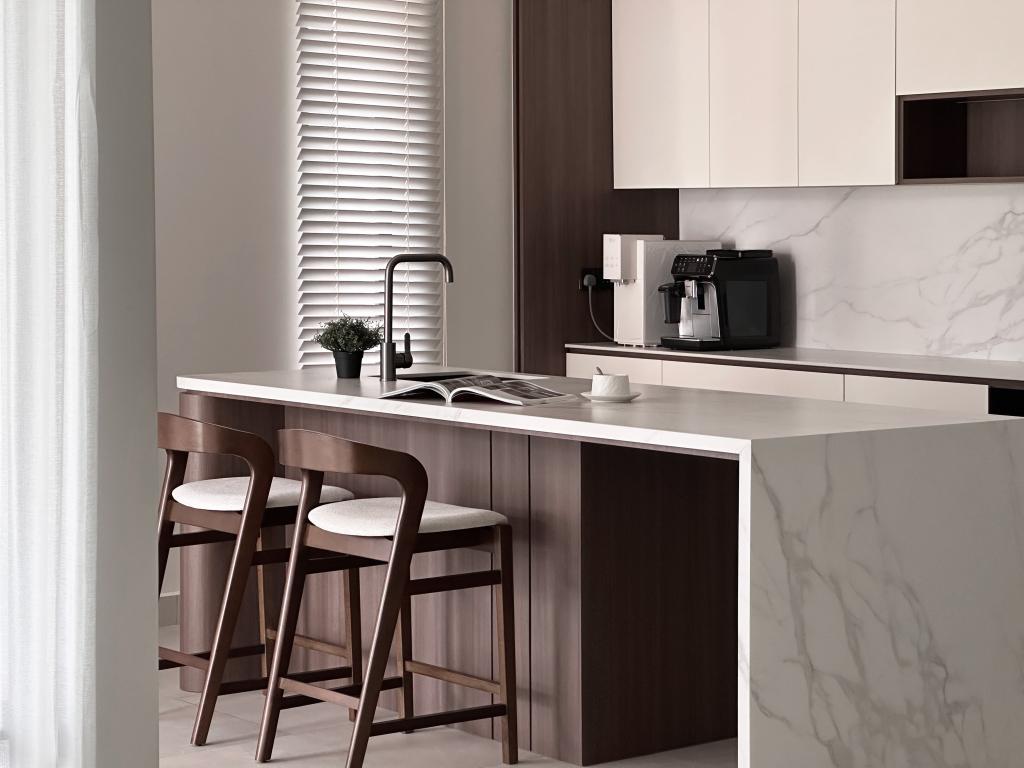
Credit : DAA Project – Soft Grain
Why Are Some Renovation Quotations Much Cheaper?
A quotation can be cheaper for many legitimate reasons.
The problem is not simply that the price is low.
The problem is when the price is low because the comparison is not like-for-like.
Common reasons include:
1. Different scope
One quotation includes hacking, disposal and reinstatement.
Another does not.
2. Different materials
One quotation specifies a premium hardware system.
Another uses a lower-cost alternative.
3. Different quantities
One company may quote 40 electrical points.
Another may quote 25.
4. Different assumptions
Some items may be priced as allowances because the final selection has not been confirmed.
5. Different project management costs
One company may include project coordination, site supervision and scheduling.
Another may operate with a much leaner site management structure.
6. Excluded work
A low quotation may intentionally exclude certain works that the homeowner assumes are included.
This is why “Company A is RM50,000 cheaper” is not enough information to make a decision.
You first need to identify where that RM50,000 difference comes from.
Should You Choose the Cheapest Renovation Quotation?
Not automatically.
The cheapest quotation can be the best option if the scope, specifications, workmanship and contractual terms are genuinely comparable.
But price should not be the only deciding factor.
A better question is:
“Which quotation gives me the clearest understanding of what I will receive for the money I am paying?”
For a substantial renovation, a quotation that is slightly higher but significantly clearer may provide more confidence than a very low quotation with numerous assumptions and exclusions.
CIDB specifically advises homeowners to be cautious about quotations that are unusually cheap when the scope of work is not clearly broken down.

Credit : DAA Project – Daily Space
How to Compare Two Renovation Quotations
The easiest way is to compare them category by category, rather than comparing the final totals.
Step 1: Compare the Scope
Put both quotations side by side.
Check:
| Category | Quotation A | Quotation B |
|---|---|---|
| Demolition | Included? | Included? |
| Flooring | Quantity + specification | Quantity + specification |
| Ceiling | Type + area | Type + area |
| Painting | Number of coats / specification | Number of coats / specification |
| Electrical | Number of points | Number of points |
| Plumbing | Scope | Scope |
| Carpentry | Quantity + specification | Quantity + specification |
| Glass | Type + thickness | Type + thickness |
| Metalwork | Specification | Specification |
| Cleaning | Included? | Included? |
The goal is not to find the lowest number.
The goal is to discover:
Are both companies actually quoting for the same renovation?
Step 2: Compare Material Specifications
Never compare only the material category.
Compare the specification.
For example, for cabinetry, check:
- Board type
- Board thickness
- Surface finish
- Internal finish
- Hardware
- Hinges
- Drawer runners
- Accessories
- Edge finishing
- Cabinet dimensions
For flooring, check:
- Tile type
- Tile size
- Tile finish
- Brand or product range
- Installation method
- Skirting
- Wastage allowance
- Hacking and disposal
For electrical work, check:
- Number of points
- Socket type
- Switch brand
- Wiring specification
- Distribution board
- Circuit requirements
- Installation
- Testing
A quotation with more words is not necessarily better.
A quotation with clearer specifications is better.

Step 3: Compare Carpentry Properly
Carpentry is one of the areas where homeowners can easily misunderstand quotations.
A quotation may state:
“Kitchen cabinet — RMXX,XXX”
But the price can depend on many variables.
Ask:
Cabinet construction
- What board is used?
- What thickness?
- What is the internal finish?
- What is the back panel specification?
Door finish
- Laminate?
- Acrylic?
- Spray paint?
- Veneer?
- Other finish?
Hardware
- Which hinge system?
- Which drawer system?
- Is soft-close included?
- Are pull-out accessories included?
Quantity
- How many feet or units?
- What height?
- Are tall cabinets included?
- Are island cabinets included?
Without this information, comparing two carpentry prices can be misleading.
Step 4: Compare Electrical Quotations
Electrical quotations should also be compared based on number and type of points, not just the total price.
For example:
Electrical works — RM12,000
does not tell you enough.
Ask:
- How many lighting points?
- How many socket points?
- How many dedicated appliance points?
- Are switches included?
- Are light fittings included?
- Is wiring included?
- Is the distribution board included?
- Are testing and commissioning included?
A quotation with 100 points and another with 60 points cannot be fairly compared simply by total price.

What Are Hidden Renovation Costs?
“Hidden costs” do not always mean a contractor is intentionally hiding money.
Sometimes they happen because the homeowner and contractor had different assumptions about what was included.
Common areas to clarify include:
Existing-condition works
Older homes can reveal unexpected conditions after demolition.
Examples may include:
- Damaged existing pipes
- Concealed wiring problems
- Uneven floors
- Water leakage
- Existing structural conditions
- Previous renovation defects
Changes requested by the homeowner
For example:
“Can we add another cabinet here?”
or:
“Can we change this tile after all?”
Once the agreed scope changes, the cost may change as well.
Provisional work
Some work cannot be fully priced until more information is available.
Product selections
Certain items may initially be based on an allowance and later cost more when the homeowner selects a higher-priced product.
The solution is not to demand that every possible future cost be included in the initial quotation.
The solution is to clearly identify what is confirmed, what is estimated and what may change.
What Are Provisional Sum and Prime Cost Items?
These terms are important when reading renovation and construction quotations.
Provisional Sum
A Provisional Sum is an allowance for work or materials where the exact scope or cost has not yet been fully determined.
For example, certain site conditions may need to be investigated before the final cost can be established.
Prime Cost Sum
A Prime Cost Sum generally refers to an allowance for an item that the homeowner will select later.
For example:
- Sanitary fittings
- Certain tiles
- Selected lighting
- Hardware
- Appliances
The important question is:
How much allowance has actually been included?
If the quotation contains a RM1,000 allowance but your eventual selection costs RM3,000, the difference may become an additional cost.
CIDB specifically identifies Provisional Sum and Prime Cost Sum as items that should be properly considered and stated in construction quotations.
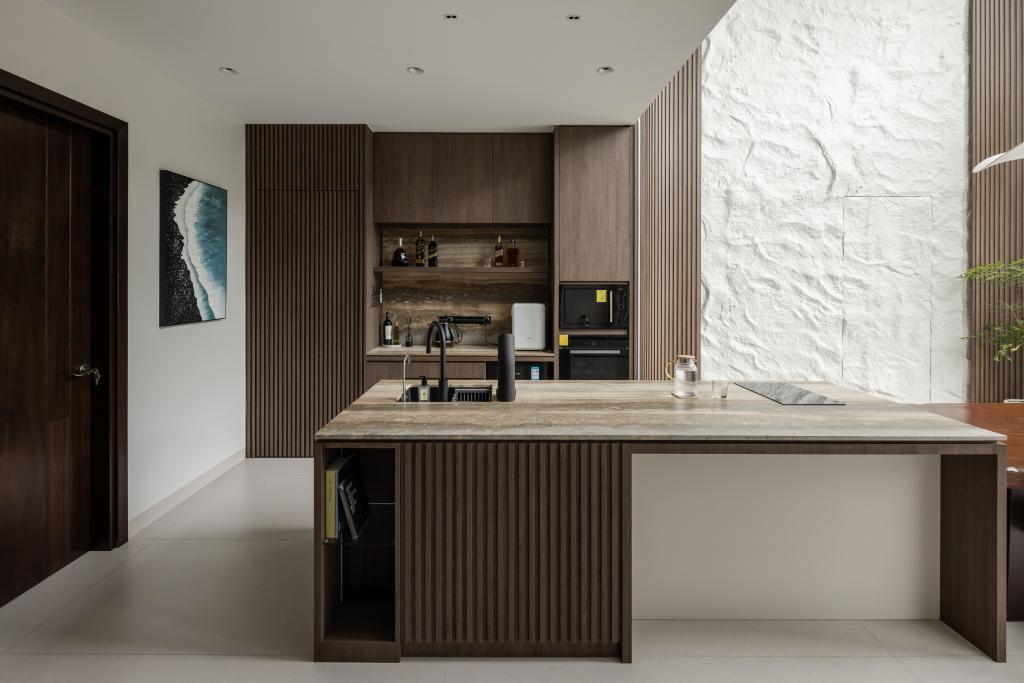
Credit : DAA Project – Serene Nest
How Do I Know If a Renovation Quotation Is Too Low?
There is no single price threshold that automatically means a quotation is “too low”.
Instead, look for unexplained differences.
For example:
Company A: RM280,000
Company B: RM275,000
Company C: RM205,000
The question should not immediately be:
“Why is Company C cheaper?”
Instead ask:
“What is different between the three quotations?”
Check:
- Scope
- Quantity
- Materials
- Hardware
- Workmanship
- Exclusions
- Provisional sums
- Prime Cost items
- Project management
- Payment terms
- Warranty
- Timeline
If the RM205,000 quotation has significantly more exclusions or lower specifications, the apparent RM75,000 saving may not represent a true saving.
How Can Homeowners Avoid Unexpected Renovation Costs?
The best way is to reduce ambiguity before construction starts.
Ask the renovation company to clarify:
1. What is included?
Get the scope documented.
2. What is excluded?
Do not rely on assumptions.
3. Which items are allowances?
Identify Provisional Sum and Prime Cost items.
4. What happens if I change something?
Understand the Variation Order process.
5. What happens if unexpected site conditions are discovered?
Understand how additional work will be assessed and approved.
6. What is the payment schedule?
Payments should be tied to clearly defined contractual terms and project progress.
7. What happens after completion?
Check warranty and defect rectification terms.
CIDB’s guidance recommends that contracts clearly address scope, project duration, payment terms, variations, delays and dispute resolution.

Credit : DAA Project – The Cream Hour
What Should I Ask Before Accepting a Renovation Quotation?
Before choosing a renovation company, ask these questions:
Scope
- Is everything I discussed included?
- What is specifically excluded?
- Are demolition and disposal included?
- Are installation costs included?
Materials
- What material specifications are included?
- Which brands or product ranges are being quoted?
- Are there alternative materials or equivalent products?
Cost
- Which items are Provisional Sums?
- Which items are Prime Cost items?
- Are there any costs that may be added later?
Changes
- How are additional works priced?
- Do I need to approve a Variation Order before additional work starts?
Project
- Who is responsible for project coordination?
- Who supervises the site?
- What is the expected project timeline?
After-sales
- What warranty is provided?
- How are defects handled after handover?
These questions can reveal far more about a renovation company’s professionalism than simply asking:
“Can you give me a better price?”
What Should I Check Before Signing a Renovation Contract?
Before signing, make sure the contract and supporting documents are consistent.
At minimum, review:
Scope of work
Make sure the final scope matches what you agreed during the design and quotation stages.
Final price
Confirm:
- Contract sum
- Included works
- Exclusions
- Allowances
- Taxes or applicable charges
- Payment schedule
Project timeline
Check:
- Start date
- Estimated completion date
- Key milestones
- Delay provisions
Variation procedure
Understand how additional work or changes are requested, priced and approved.
Warranty
Understand:
- What is covered
- Warranty period
- How defects are reported
- Who handles rectification
Termination and dispute procedures
Know what happens if either party fails to meet its obligations.
CIDB recommends written contracts that clearly establish responsibilities, scope, price, payment terms, variation procedures, delays, termination and dispute resolution.
A Renovation Quotation Should Give You Confidence, Not Confusion
A good renovation quotation should answer one fundamental question:
“What exactly am I paying for?”
If you cannot understand the scope, specifications, exclusions and payment terms, the final price alone does not give you enough information to make a confident decision.
This is especially important for larger residential renovation projects, where the project involves multiple trades and decisions across design, construction, carpentry, electrical, plumbing, finishes and installation.
The better approach is to compare value, scope and accountability — not just price.

How DAA Design Approaches Renovation Quotations
At DAA Design, we believe a renovation quotation should be more than a final number.
For a homeowner, it should provide a clear connection between:
Design → Scope → Specification → Cost → Construction
Our approach is built around helping homeowners understand what they are investing in before construction begins.
For a full design and renovation project, this means coordinating the different components of the project rather than leaving homeowners to independently manage multiple contractors and trades.
The objective is simple:
Clearer planning. Clearer quotation. Clearer responsibility.
This is particularly important for homeowners looking for a one-stop interior design and renovation team in Johor Bahru or Kuala Lumpur, where design decisions and construction decisions need to work together.
A transparent quotation does not necessarily mean being the cheapest.
It means the homeowner can understand what is included, what is excluded, what is specified and what may change.
That clarity creates a stronger foundation for the renovation project.
Renovation Quotation Checklist
Before you choose a renovation company, check whether you can answer all of these questions:
- Is the full scope of work clearly stated?
Are quantities and measurements clear?
- Are important material specifications stated?
- Are carpentry specifications clear?
- Are electrical points clearly stated?
- Are exclusions clearly stated?
- Are Provisional Sum items identified?
- Are Prime Cost items identified?
- Are payment terms clear?
- Is the renovation timeline stated?
- Is the Variation Order process explained?
- Is the warranty stated?
- Are defect rectification procedures clear?
- Does the contract match the final quotation?
- Do you understand exactly what you are paying for?
If you cannot answer several of these questions, do not compare the quotations by price yet.
Go back and clarify the scope first.

Credit : DAA Project – Luxe Noir Realm
Frequently Asked Questions
1. What should a renovation quotation include?
A renovation quotation should clearly state the project scope, quantities where applicable, material specifications, prices, exclusions, payment terms and relevant allowances. Depending on the project, it should also clarify items such as Provisional Sums, Prime Cost items, warranty and variation procedures.
2. Why are some renovation quotations much cheaper?
The difference may come from different scopes, quantities, material specifications, workmanship, exclusions or allowances. A cheaper quotation should therefore be compared line by line rather than judged by the total price alone.
3. Should I choose the cheapest renovation quotation?
Not necessarily. Choose the quotation that provides the best combination of clearly defined scope, appropriate specifications, workmanship, project management, contractual protection and price.
4. How do I compare quotations from different renovation companies?
First standardise the comparison. Compare the same scope, quantities, materials, finishes, hardware, exclusions, allowances, payment terms and warranty provisions before comparing the final price.
5. What costs are commonly left out of renovation quotations?
This depends on the project. Possible exclusions may include selected appliances, loose furniture, decorative items, professional fees, authority-related fees, specialist works or additional work resulting from changes or unforeseen site conditions. Always check the quotation’s exclusion section.
6. What are hidden renovation costs?
They are costs that homeowners did not expect to pay because they were not clearly understood or identified in the original scope. They can arise from exclusions, changes, unforeseen site conditions or allowances that are later exceeded.
7. How should I compare material specifications?
Compare the actual specification rather than the material name. Check the type, grade, thickness, finish, brand or product range, hardware and installation requirements where relevant.
8. How should I compare carpentry quotations?
Compare cabinet dimensions, quantity, board specifications, door finish, internal construction, hardware, accessories, installation and other included components. Cabinet “price per foot” alone is not enough for a proper comparison.
9. How should I compare electrical quotations?
Compare the number and type of electrical points, wiring scope, switches, sockets, dedicated appliance points, distribution board requirements and installation. Two electrical quotations with different numbers of points are not directly comparable.
10. How do I know if a quotation is too low?
Look for unexplained differences in scope, materials, quantities, exclusions and allowances. A very low price is not automatically a problem, but it deserves a more detailed comparison.
11. What questions should I ask before accepting a quotation?
Ask what is included, what is excluded, what materials are specified, which items are allowances, how variations are handled, who manages the project, what the timeline is and what warranty is provided.
12. What should I check before signing a renovation contract?
Check the final scope, contract price, exclusions, payment schedule, project timeline, variation procedure, warranty, delay provisions, termination terms and dispute-resolution process. Make sure the contract matches the quotation and other agreed project documents.
Final Takeaway
The best renovation quotation is not necessarily the cheapest quotation.
It is the quotation that allows you to understand:
What you are getting.
What you are paying for.
What is not included.
What may change.
And who is responsible for what.
Before choosing a renovation company in JB or KL, compare the quotation scope by scope, specification by specification and responsibility by responsibility.
Once the quotations are genuinely comparable, the price becomes much more meaningful.
For homeowners looking for a professional one-stop interior design and renovation team, transparent quotation is only one part of the decision.
The bigger question is whether the company can connect design planning, quotation, project coordination and construction execution into one clear process.
Because a renovation budget is easier to control when the scope is clear from the beginning.
About DAA Design
DAA Design Associates Sdn Bhd is an interior design and renovation company serving residential homeowners in Johor Bahru and selected projects in Kuala Lumpur.
Our approach combines interior design, space planning, quotation planning and renovation execution under one coordinated process, helping homeowners move from design decisions to construction with clearer planning and communication.
Design Defines Living.
If you are planning a landed home, villa or any residential renovation in JB or KL, speak with DAA Design about your project, budget and renovation requirements.
Planning a Renovation in JB or KL?
Before comparing renovation quotations, make sure you understand your scope, budget and design requirements.