




Planning a home renovation in Malaysia? Learn the difference between an interior designer, renovation contractor, architect and design-and-build company — and understand which renovation approach is right for your home, budget and project complexity.
Choosing who to hire for a renovation is one of the first decisions a homeowner needs to make.
Should you hire an interior designer first?
Can a renovation contractor handle the design?
Do you need an architect?
Or would it be easier to work with one company that handles both design and construction?
The answer depends on the type of property, scope of renovation, complexity of the project and how much coordination is required.
For homeowners in Johor Bahru and Kuala Lumpur, understanding these differences before signing a renovation contract can help avoid unclear responsibilities, communication gaps, unexpected costs and delays.
This guide explains the differences between interior designers, contractors, architects and design-and-build companies, and what you should consider before choosing a renovation partner.
There is no single solution that is best for every renovation.
As a general guide:
| Your Renovation Situation | Suitable Approach |
|---|---|
| Mainly construction work based on completed drawings | Renovation Contractor |
| You need help with interior planning, materials and aesthetics | Interior Designer |
| Structural changes, extensions or regulatory requirements | Architect + relevant consultants |
| You want design, quotation, construction and project management coordinated together | Design & Build |
| Large landed house or high-value renovation | Design & Build / Integrated Team |
| Complex renovation involving multiple trades | Design & Build / Strong Project Management |
The important question is not simply “Which service is cheaper?”
A better question is:
“Who will be responsible for connecting the design, quotation, construction and project management from beginning to end?”
That responsibility can make a significant difference to the renovation experience.
An interior designer focuses primarily on how the interior space looks, functions and supports the homeowner’s lifestyle.
Depending on the company and scope of service, an interior designer may be involved in:
For example, if you are renovating a landed house in Johor Bahru, an interior designer may help determine:
However, not every interior designer provides construction services.
Some firms provide design services only, while others work together with external contractors.
This distinction is important because the person who creates the design may not necessarily be the person responsible for building it.
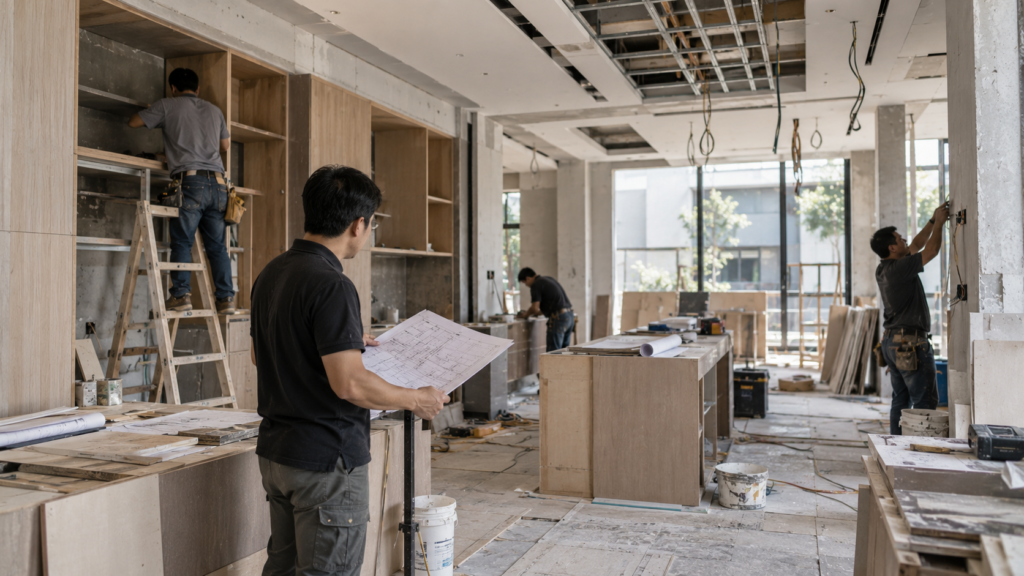
A renovation contractor is primarily responsible for carrying out construction and renovation works.
Depending on the scope, contractors may coordinate trades such as:
If you already have a completed design, drawings and specifications, a contractor may be appointed to execute the renovation.
The contractor’s primary responsibility is generally construction execution, rather than developing the overall interior design concept.
This can work well for homeowners who:
The challenge can arise when the design and construction responsibilities are divided between different parties.
The simplest way to understand the difference is:
An interior designer plans what the space should become. A contractor builds it.
However, real renovation projects are rarely that simple.
A renovation involves many decisions that connect design and construction.
For example, changing a kitchen island may affect:
If the design team and construction team are separate, these decisions may require additional coordination.
Typically focuses on:
Design → Planning → Materials → Drawings → Visualisation
Typically focuses on:
Construction → Trades → Site Execution → Installation
Neither role is inherently better.
The more important question is:
How will the two sides communicate and coordinate throughout the project?
Architects and interior designers both influence the built environment, but their responsibilities are different.
An architect generally focuses on the building itself, including aspects such as:
An interior designer focuses more specifically on the interior environment, including:
For a simple cosmetic interior renovation, you may not necessarily need an architect.
However, an architect or relevant qualified consultant may become important when the project involves structural changes, extensions, major alterations or statutory requirements.
The exact requirements depend on the property and scope of work, so homeowners should confirm the relevant professional and authority requirements before construction begins.
Not every renovation requires an architect.
For example, a project involving:
may not require architectural services.
However, professional architectural involvement may be necessary or advisable when the project includes more substantial building changes, such as:
This is why renovation planning should begin by identifying what you are actually changing.
A homeowner should not choose a service provider simply based on the job title.
Choose the professional team according to the scope and complexity of the project.
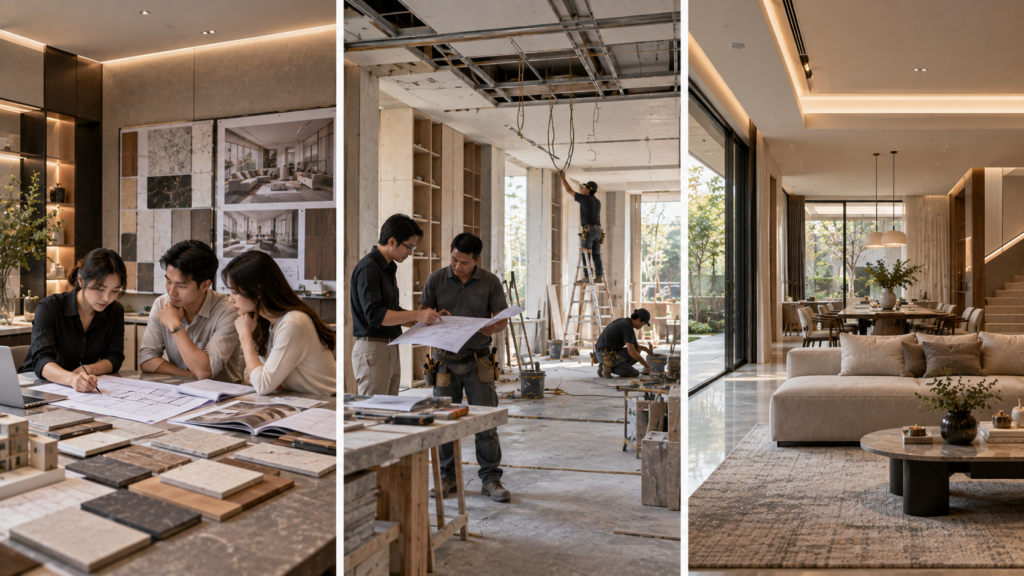
Design & Build is an integrated renovation approach where the design and construction services are managed under one company or coordinated through one integrated team.
Instead of having:
Designer → Contractor → Separate coordination
the process can be structured as:
Design → Quotation → Planning → Construction → Project Management
under one overall team.
This creates a single point of responsibility for the homeowner.
At DAA Design, this integrated approach forms an important part of how we manage residential renovation projects.
Our role is not simply to produce an attractive 3D visualisation.
The design needs to be developed with construction, materials, budget, site conditions and project execution in mind.
This is an important distinction.
The primary focus is:
Designing the space.
The focus is:
Designing and delivering the space.
A design-and-build company can potentially connect decisions made during the design stage directly with construction planning.
For example:
Design decision
The homeowner wants a full-height kitchen cabinet.
↓
Construction consideration
Cabinet dimensions, electrical points, lighting and appliance positions are coordinated.
↓
Quotation
The relevant work and materials are included in the project scope.
↓
Construction
The site team executes the design according to the agreed drawings and specifications.
This creates a more connected workflow.
For homeowners, one of the biggest advantages is coordination.
Instead of constantly communicating between different parties, the homeowner can work primarily with one team.
This can make communication more straightforward, particularly for larger renovations.
Design decisions can be evaluated against actual construction requirements earlier.
For example:
“Can this cabinet be built this way?”
“Will this lighting position work?”
“Does the ceiling height allow for this detail?”
“Where should the electrical point be located?”
These questions can be addressed as part of the design and planning process rather than only after construction begins.
When design and construction are handled by completely separate companies, homeowners may sometimes find themselves coordinating between parties when something needs clarification.
With an integrated design-and-build structure, there is a clearer overall party responsible for coordinating the project.
That does not mean every issue automatically disappears.
But it can reduce the “designer says this, contractor says that” situation.
A design should not exist independently from the renovation budget.
Material selection, carpentry details, construction methods and design complexity can all affect cost.
An integrated team can evaluate these factors together during the planning process.
This helps homeowners make more informed decisions before construction starts.
Renovation involves multiple trades.
For example:
Demolition → Masonry → Electrical → Plumbing → Ceiling → Flooring → Painting → Carpentry → Installation
One delay can affect the next trade.
A coordinated project management team can plan the sequence of works and monitor progress across different stages.
Not necessarily.
The price of a renovation depends on many factors, including:
Therefore, it is not accurate to say:
“Design & Build is always cheaper.”
It is also not accurate to say:
“Design & Build is always more expensive.”
The more useful comparison is the total project value and responsibility, rather than comparing only the initial design fee or construction price.
A lower quotation may not necessarily represent a lower final cost if important items are excluded or coordination problems create variations later.
It depends on the homeowner and the project.
This approach may suit homeowners who:
This approach may suit homeowners who:
For a straightforward renovation, either approach can work.
For a complex landed-home renovation, however, coordination becomes increasingly important.
This is one of the most important questions homeowners should ask before signing a renovation agreement.
If the designer and contractor are separate companies, responsibility may be divided according to their respective contracts.
For example:
Design issue → Designer
Construction issue → Contractor
Coordination issue → May require both parties to resolve
This can become complicated when a problem involves both design and construction.
With an integrated design-and-build company, the overall project responsibility can be more clearly coordinated through one organisation, subject to the terms of the contract.
Before signing, homeowners should always clarify:
A professional renovation company should be able to explain these responsibilities clearly.
A renovation project rarely involves only one trade.
A typical residential renovation may involve:
Someone needs to coordinate when each trade enters the site and how their work connects.
For example, electrical works may need to be completed before certain ceiling works, while carpentry measurements may only be finalised after flooring or wall conditions are confirmed.
This is where project management becomes important.
The question homeowners should ask is:
“Who is actually managing the site and coordinating all these trades?”
Not simply:
“Who is doing the renovation?”
A renovation timeline should not be treated as a simple list of dates.
It is a sequence of dependent activities.
For example:
Design approval
↓
Detailed drawings
↓
Quotation confirmation
↓
Material confirmation
↓
Site preparation
↓
Demolition
↓
Electrical & plumbing
↓
Ceiling & flooring
↓
Painting
↓
Custom carpentry
↓
Furniture & installation
↓
Final inspection
A delay at one stage can affect the following stages.
This is why a structured master programme and regular site coordination can be valuable, especially for larger residential projects.
Before choosing an interior designer, contractor or design-and-build company, look beyond the portfolio.
Ask these questions:
Do you have one person or team coordinating the project?
Make sure you understand the scope of work, materials and exclusions.
Ask whether detailed drawings are provided before construction.
Find out whether there is a dedicated site supervisor or project manager.
A professional quotation should allow you to understand what you are paying for.
Ask how variations, upgrades and additional works are priced and approved.
Ask whether the company provides a project schedule or master programme.
Understand the defect rectification and warranty process.
These questions can tell you much more about a company’s professionalism than a beautiful Instagram portfolio.
A good design-and-build company should be able to connect design thinking with construction execution.
Look for evidence of:
Can they develop a design around your lifestyle, space and requirements?
Do they have a structured process before construction starts?
Can they clearly explain what is included, excluded and why certain costs exist?
Who coordinates the site and different trades?
How are materials specified, ordered and checked?
Can the company actually execute the details shown in the design?
What happens when the renovation is completed?
These are the areas homeowners should evaluate before choosing a renovation partner.
At DAA Design, we believe residential renovation should not be separated into disconnected design and construction decisions.
A home is not simply a collection of beautiful rooms.
The design affects:
That is why our approach connects the design stage with construction planning from the beginning.
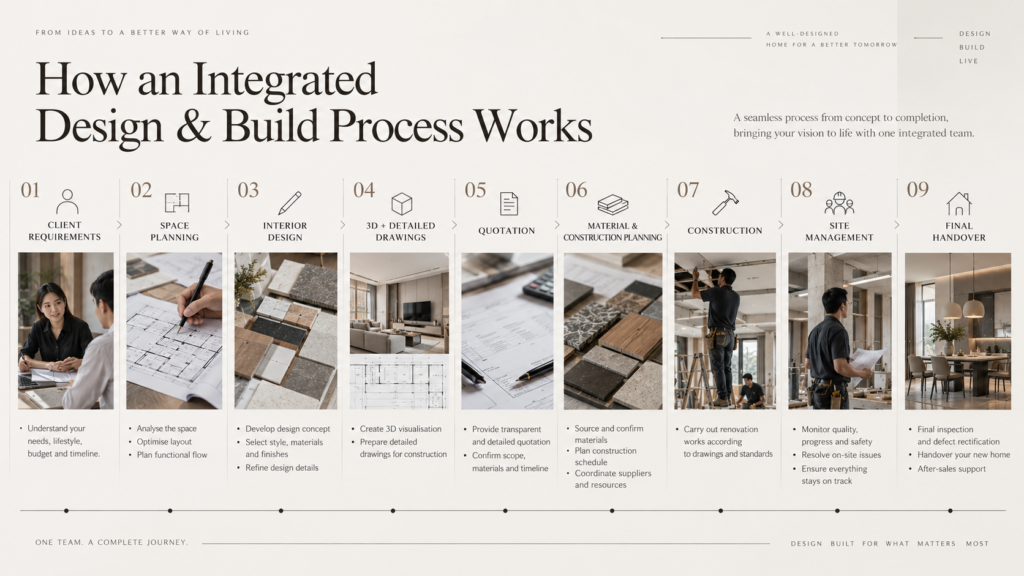
Our residential renovation process covers key stages including:
Initial Consultation → Design & Space Planning → 3D Visualisation → Detailed Drawings → Quotation → Material & Construction Planning → Site Management → Construction → Final Handover
This integrated approach is particularly valuable for homeowners undertaking high-value landed house renovations, villa renovations and larger residential projects where multiple design and construction decisions need to work together.
Our goal is not simply to design a space that looks good in a rendering.
It is to create a design that can be planned, coordinated and built properly in the real world.
| Interior Designer | Renovation Contractor | Design & Build | |
|---|---|---|---|
| Interior Concept | ✓ | Usually limited | ✓ |
| Space Planning | ✓ | Limited | ✓ |
| 3D Visualisation | Often | Not always | ✓ |
| Detailed Design | ✓ | Based on drawings | ✓ |
| Construction | Depends on company | ✓ | ✓ |
| Site Coordination | Depends on scope | ✓ | ✓ |
| Material Coordination | Depends on scope | ✓ | ✓ |
| Project Timeline | Depends on scope | ✓ | ✓ |
| Single Overall Responsibility | Depends on contract | Construction-focused | ✓ |
| Design + Construction Integration | Depends on setup | Limited | ✓ |
The important point is that these categories are not completely interchangeable.
An interior designer, contractor and design-and-build company can all play important roles in a renovation.
The right choice depends on what you are renovating and how much responsibility you want one team to take on.
If you already have a complete design and simply need someone to execute the work, a renovation contractor may be suitable.
If you need help developing the interior concept, layout, materials and overall aesthetic, an interior designer may be the right starting point.
If your project involves significant structural changes, extensions or regulatory requirements, you may need an architect and relevant consultants.
If you want design, quotation, construction and project management to work together under one coordinated team, a design-and-build company may be the most suitable approach.
For homeowners planning a larger residential renovation, particularly a landed home or villa, the ability to coordinate all these decisions can become just as important as the design itself.
Yes, depending on the company’s service scope.
Some interior design firms provide design only, while others provide construction management or full renovation services.
Always confirm whether construction is carried out directly by the company, through appointed contractors or through a separate party.
Yes.
A design-and-build company can potentially manage the project from design development through construction and handover.
However, homeowners should still confirm exactly what is included in the company’s scope and contract.
It can be particularly useful for larger landed-home renovations because these projects often involve multiple trades, custom carpentry, electrical and plumbing coordination, ceiling works, flooring and other construction activities.
The more complex the project becomes, the more important coordination can be.
It can be, especially when the renovation involves substantial design development and multiple construction trades.
However, budget alone should not determine the choice.
The key consideration is the complexity, scope and level of coordination required.
Not necessarily.
A quotation should be evaluated based on:
Two quotations with very different prices may not actually be comparing the same scope of work.
The biggest advantage is integration.
Instead of treating design and construction as separate processes, the two can be planned together under one coordinated team.
This can make communication, budgeting, construction planning and project management more straightforward.
When choosing a renovation partner, the question is not simply:
“Should I hire an interior designer or contractor?”
A better question is:
“Who can take responsibility for turning my renovation idea into a properly planned and executed home?”
For smaller or straightforward projects, hiring separate specialists can work perfectly well.
For more complex residential renovations, having design, quotation, construction and project management connected under one team can reduce coordination gaps and give homeowners a clearer renovation journey.
At DAA Design, our approach is built around integrated residential design and build, combining design planning with construction execution and project management.
Because good renovation is not only about how a home looks.
It is also about how well the design is planned, coordinated and built.
Design Defines Living.
If you are planning a landed house, villa or high-value residential renovation in Johor Bahru or Kuala Lumpur, speak to DAA Design about your project requirements, design direction and renovation scope.
From design planning to construction, our team helps bring the entire renovation process together under one coordinated approach.
DAA Design Associates Sdn Bhd
Integrated Residential Design & Build
Johor Bahru & Kuala Lumpur, Malaysia